
Влияние коллоидных растворов наночастиц оксидов металлов на развитие ростков риса
Влияние коллоидных растворов наночастиц оксидов металлов на развитие ростков риса

Аннотация
Целью данной работы было изучить и сравнить влияние коллоидных растворов наночастиц оксидов разных металлов на развитие ростков риса. Коллоидные водные растворы оксидов меди, никеля и вольфрама были получены высоковольтным импульсным электродуговым методом. Средний размер наночастиц составил 20–25 нм. Методом последовательных разбавлений в дистиллированной воде готовились серии растворов с концентрациями от 25 до 10−6 мг/л. В работе использовался рис сорта «Виктория», созданный Всероссийским институтом риса (Краснодар). Семена помещались в коллоидный раствор и выдерживались в нем 45 минут при комнатной температуре. Контрольные семена замачивались в чистой дистиллированной воде. Затем семена высаживались в биогрунт универсальный (ТУ 0390-002-41082808-10). Длина проростков риса измерялась дважды, после 11 и 16 суток. Было обнаружено, что предварительное замачивание в коллоидном растворе наночастиц оксида никеля NiO существенно ускоряет рост растений риса. Так, после 16 суток длина проростков из обработанных семян более чем вдвое превышает длину контрольных растений. Семина риса, предварительно обработанные коллоидным раствором наночастица оксида меди CuO продемонстрировали лишь небольшое ускорение роста по сравнению с контрольными образцами, а обработка коллоидным раствором оксида вольфрама WO3, даже привела к небольшому замедлению роста по сравнению с контролем. Таким образом, предварительное замачивание семян риса в коллоидных растворах оксидов различных металлов может существенно зависеть от типа металла и может сильно повысить скорость развития растений.
1. Introduction
Metal oxide nanoparticles exert a significant influence on a wide variety of living organisms
. They can stimulate plant growth and development , interact with plant, animal, and human cells , and exhibit antimicrobial and fungicidal activity . In more detail these aspects are described below in the Discussion section. Research published to date indicates that the potential impact of metal oxide nanoparticles on plants is immense and warrants further investigation. Rice is one of the world’s most important agricultural crops, serving as a staple food for half of humanity. Global rice production amounts to 90 kg per capita. Achieving high and stable yields requires timely, uniform, and robust seedling emergence at an optimal plant density. When sowing cereal crops, it is crucial that germination is rapid and uniform. Sparse emergence often necessitates either the application of higher doses of nitrogen fertilizers — to promote tillering and restore the crop stand — or the need for re-sowing, both of which increase the production cost of the grain. Seed treatment helps plants overcome these types of stress factors; it is particularly essential under conditions such as low soil temperature, moisture deficiency, or when employing zero-tillage or minimum-tillage cultivation practices. Other challenges — such as low seed germination rates or issues arising from deep sowing — can also be addressed by treating seeds with specialized formulations. Supporting the plant at this stage of development, boosting its immunity, and enhancing the vital processes of the embryo are key objectives. Treating seeds with microelements and growth stimulants triggers metabolic processes within the grain, regulates hormonal balance, and promotes the development of primary roots — as well as the emergence of secondary roots should the plant encounter stress. Consequently, there is a need to develop new methods for enhancing seed germination, which would facilitate high yields even under conditions of high planting density. The objective of this study was to investigate the effect of colloidal solutions containing copper, nickel, and tungsten oxide nanoparticles on the germination of rice seeds and the development of rice sprouts.2. Experimental
The study utilized the "Victoria" rice variety, which was breeded by the All-Russian Rice Research Institute (Krasnodar). This variety belongs to the mid-season group, with a growing period of 116–118 days. The physical basis for the used processing method—also known as electro-erosion machining—is the phenomenon of electrical erosion. During electrical erosion, a metal surface is degraded by the action of an electrical pulse discharge. When two electrodes, held at a voltage sufficient to cause a dielectric breakdown of the gap between them, are brought close together, an electrical spark discharge occurs in the form of a narrow conductive channel. This closes the electrical circuit at that point, generating temperatures on the order of thousands to tens of thousands of degrees. The metal melts and partially evaporates. As a result, mainly spherical particles are produced (see Figs 1 and 2 below). In literature other methods for synthesis of metal oxide nanoparticles are also described, they allow to produce nanoparticles of various morphologies, for example, nanorods, nanoplates, nanospheres, nanoboxes, hexagonal, tripods, tetrapods, nanowires, nanotubes, nanorings, nanocages, and nanoflowers
.All solutions were prepared using a serial dilution method. In every case, distilled water served as the solvent. Concentrations ranging from 25 to 10−6 mg/l were used. For each concentration, 10 seeds were placed into the colloidal solution at room temperature (25.4°C) and left to soak for 45 minutes. Following this, the rice seeds were transferred to small seedling trays containing prepared soil and watered. Germination studies were conducted in accordance with the GOST 12038-84 standard, "Agricultural crop seeds: Methods for determining germination." This paper presents the results regarding the average size of the sprouts after several days of growth.
Universal organic soil mix produced according to technical conditions TU 0390-002-41082808-10 is a ready-to-use, nutrient-rich substrate designed for growing vegetable and flower seedlings. It is suitable for fertilizing vegetables, leafy greens, ornamental plants, flowers, fruit-bearing and ornamental shrubs and trees, as well as for preparing seedling substrates, establishing lawns, greenhouses, garden beds, cold frames, and flower beds, and for use in landscape gardening. Composition: The universal organic soil mix is produced from a blend of low-lying (fen) peat, upland (sphagnum) peat, and "Biocompost" (cattle-manure-based organic fertilizer), with the addition of loosening agents (agro-perlite, vermiculite) and liming materials (chalk or limestone flour). Moisture content: no more than 65%. pH (in KCl): 5.5–6.5. Nutrient content (minimum values): nitrogen (total ammonium and nitrate nitrogen) 250–350 mg/l; phosphorus (calculated as P2O5) 250–350 mg/l; potassium (calculated as K2O) — 350–450 mg/l. For structural analysis, a high-resolution transmission electron microscope (TEM) JEM 2100 manufactured by JEOL (Japan) was used.
3. Results
Figure 1 shows a TEM micrograph and an electron diffraction pattern of copper oxide (CuO) particles obtained from an aqueous solution with a concentration of 15 mg/l. The copper peroxide nanoparticles appear as small aggregates, with an average individual particle size of 20 nm. Analysis of the crystal lattice indicates that the dispersed copper particles react chemically with the oxygen dissolved in the distilled water, resulting in the formation of copper peroxide particles. The majority of the particles are crystalline and exhibit a rounded shape.
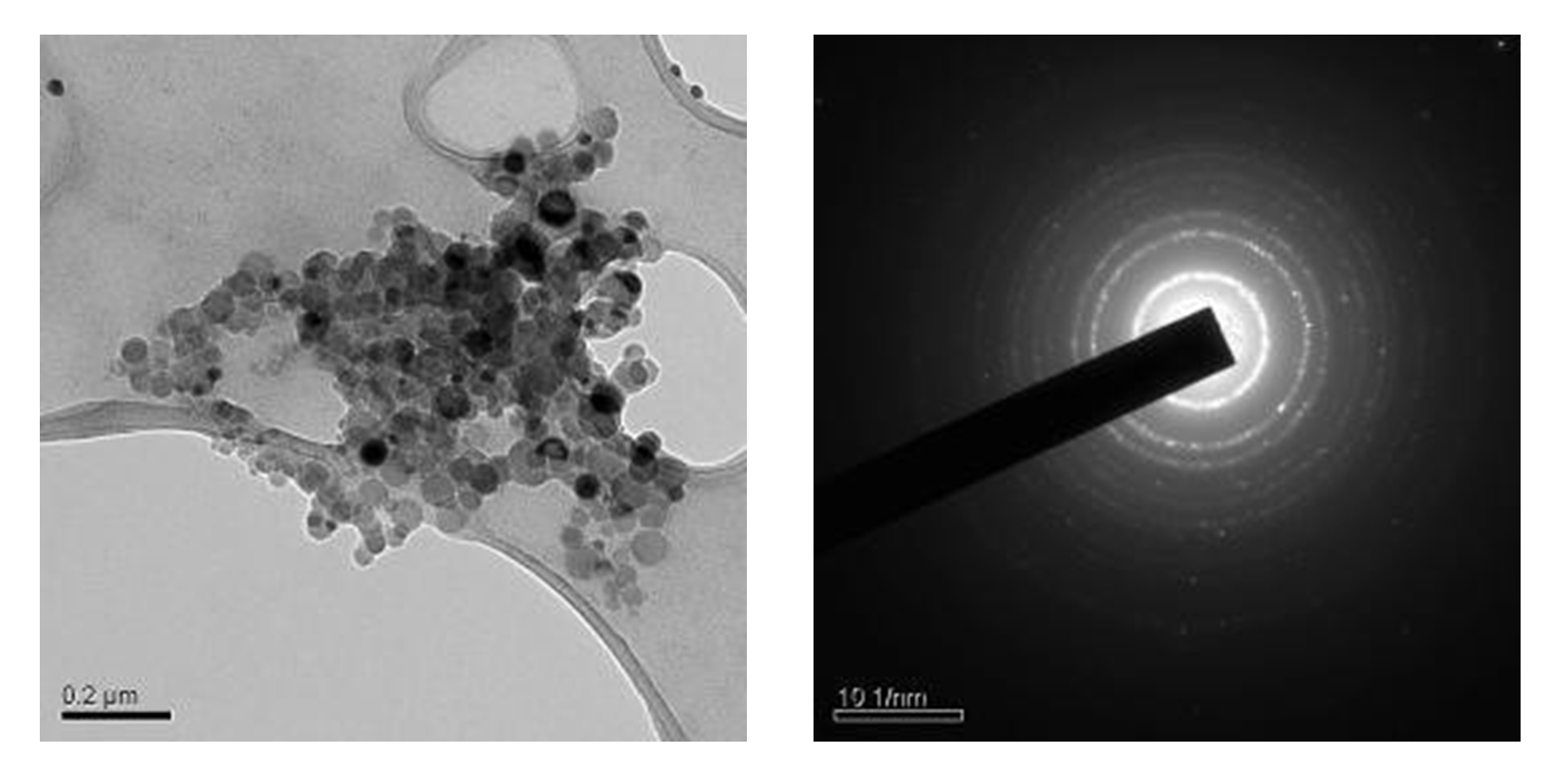
TEM micrograph and electron diffraction pattern of copper oxide (CuO) particles from an aqueous solution with a concentration of 15 mg/l
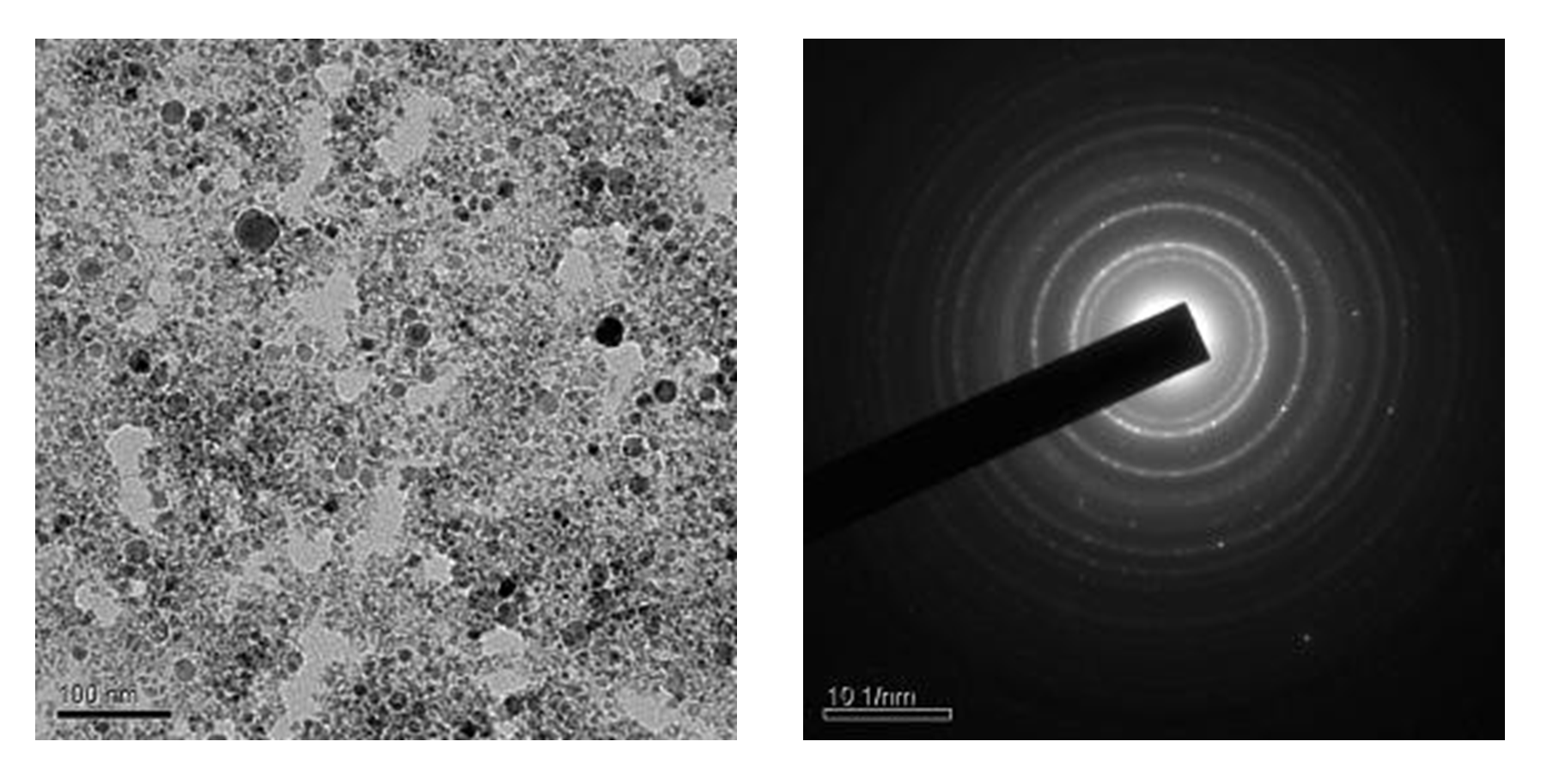
TEM micrograph and electron diffraction pattern of nickel oxide (NiO) particles from an aqueous solution with a concentration of 25 mg/l
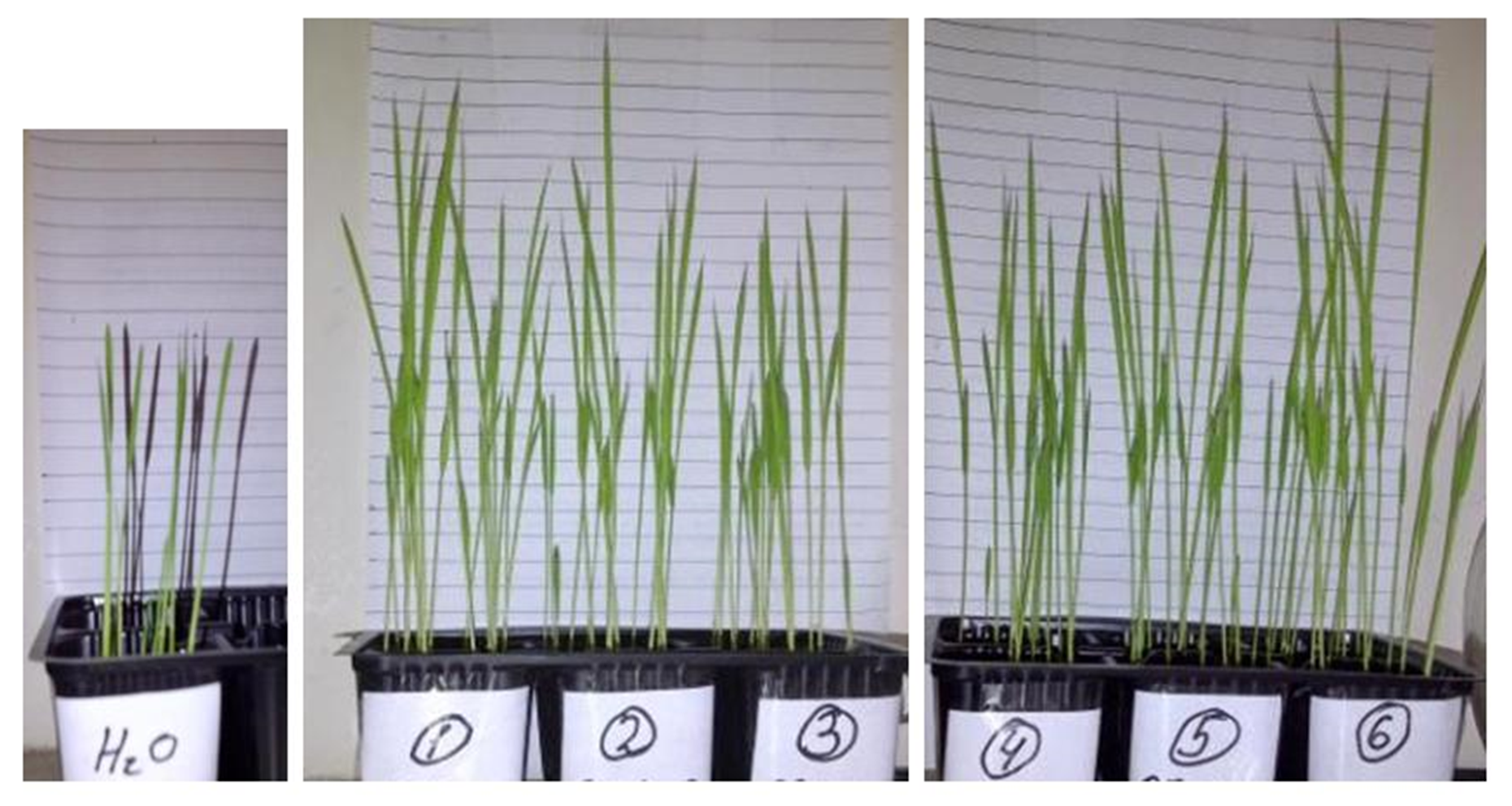
Development of rice seedlings 20 days after pre-sowing treatment by soaking in a colloidal nickel oxide solution for 45 minutes, the numbers on the pots indicate the concentrations of the colloidal solutions used for the pre-sowing soak:
1 - 25; 2 - 2.5; 3 - 0.25; 4 - 0.025; 5 - 0.0025; 6 - 0.00025 mg/l
the control sample, consisting of seeds soaked in pure distilled water, is shown on the left; in the background, markings are drawn at 1 cm intervals
Figure 3 shows a photograph of rice seedlings after pre-sowing treatment by soaking in a colloidal solution of nickel oxide for 45 min. on the 20th day of growth. The numbers on the pots indicate the concentration of the colloidal pre-soak solution: (1) 25, (2) 2.5, (3) 0.25, (4) 0.025 (5) 0.0025 and (6) 0.00025 mg/l. Shown on the left is a control sample for seeds soaked in pure distilled water. As we can see, preliminary soaking in a colloidal solution containing nickel oxide nanoparticles significantly accelerates plant growth compared to the control.
Figure 4a shows the dependence of rice seedling length on the concentration of a colloidal solution of nickel oxide for preliminary soaking for 45 minutes, measured 11 days (red dots) and 16 days (blue dots) after the treated seeds were planted in the soil (see also Table 1). It is clearly evident that treating rice seeds in a colloidal solution containing NiO nanoparticles significantly accelerates plant growth. Paradoxically, this growth acceleration tends to increase slightly as the concentration of nanoparticles decreases.
Figure 4b shows the dependence of rice seedling length on the concentration of a colloidal solution of copper oxide (CuO) for preliminary soaking for 45 minutes, measured 11 days (red dots) and 16 days (blue dots) after the treated seeds were planted in the soil (see also Table 1). It is evident that treating rice seeds with a colloidal solution containing copper oxide (CuO) nanoparticles also accelerates plant growth, though only slightly. Furthermore, unlike with nickel oxide, plant growth is accelerated somewhat more effectively when higher-concentration solutions are used.
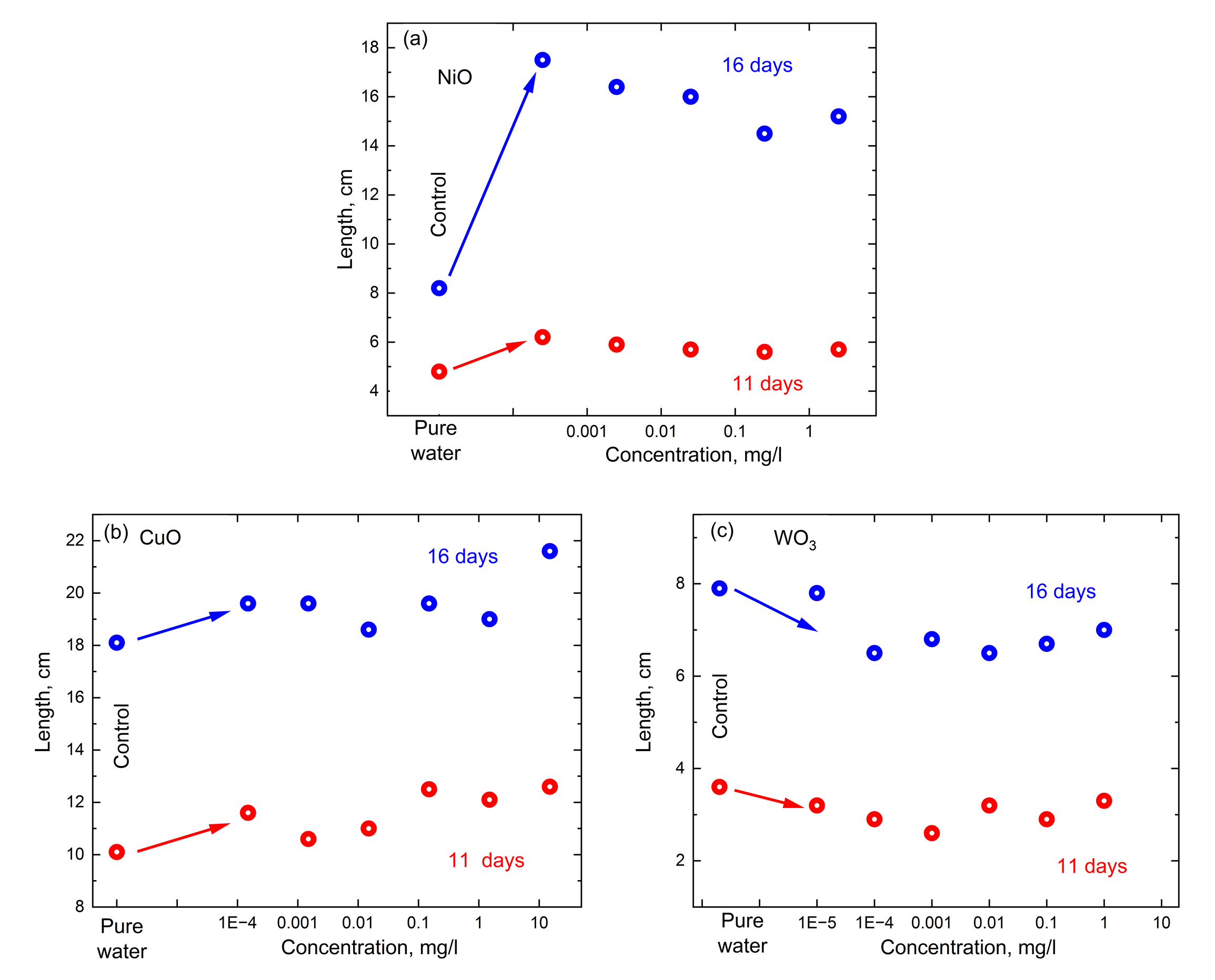
Dependence of rice seedling length on the concentration of a colloidal solution of nickel (a), copper (b), or tungsten (c) oxides — used for pre-sowing seed treatment (soaking for 45 min) — as measured several days after the treated seeds were planted in soil
Rice seedling length for various concentrations of a colloidal solution of nickel, copper, and tungsten oxides as measured several days after the treated seeds were planted in soil
NiO concentration, mg/l | Length after 11 days, cm | Length after 16 days, cm | CuO concentration, mg/l | Length after 11 days, cm | Length after 16 days, cm | WO3 concentration, mg/l | Length after 11 days, cm | Length after 16 days, cm |
Pure water, control | 4.8 | 8.2 | Pure water, control | 10.1 | 18.1 | Pure water, control | 3.6 | 7.9 |
2.5 10−4 | 6.2 | 17.5 | 1.5 10−4 | 11.6 | 19.6 | 1 10−5 | 3.2 | 7.8 |
0.0025 | 5.9 | 16.4 | 0.0015 | 10.6 | 19.6 | 1 10−4 | 2.9 | 6.5 |
0.025 | 5.7 | 16 | 0.015 | 11 | 18.6 | 0.001 | 2.6 | 6.8 |
0.25 | 5.6 | 14.5 | 0.15 | 12.5 | 19.6 | 0.01 | 3.2 | 6.5 |
2.5 | 5.7 | 15.2 | 1.5 | 12.1 | 19 | 0.1 | 2.9 | 6.7 |
|
|
| 15 | 12.6 | 21.6 | 1 | 3.3 | 7 |
4. Discussion
How we can understand the influence of the oxide nanoparticles on the rice growth and the differences in the action of different oxides? Recently, the various aspects of the influence of oxide nanoparticles on living organisms were analyzed in Refs. , , , . For example, zinc oxide nanoparticles (NPs) are effective against microorganisms such as Bacillus subtilis, Bacillus megaterium, Staphylococcus aureus, Sarcina lutea, Escherichia coli, Pseudomonas aeruginosa, Klebsiella pneumonia, Pseudomonas vulgaris, Candida albicans, and Aspergillus niger . The mechanism of action has been ascribed to the activation of zinc oxide nanoparticles by light, which penetrate the bacterial cell wall via diffusion
. It has been confirmed from SEM and TEM images of the bacterial cells that zinc oxide nanoparticles disintegrate the cell membrane and accumulate in the cytoplasm, where they interact with biomolecules, causing cell apoptosis leading to cell death . The zinc oxide nanoparticles stimulated the growth of coffee plants (Coffea arabica L.) . For example, the one-year-old coffee plants were grown in greenhouse conditions and treated with two foliar applications of 10 mg/l of Zn as either zinc sulfate monohydrate (ZnSO4‧H2O) or zinc oxide nanoparticle (ZnO NPs 20% w/t) and compared to untreated control plants over the course of 45 days . X-ray micro-analyses maps demonstrated the increased penetrance of ZnO NPs in coffee leaf tissue. Overall, ZnO NPs had a more positive impact on coffee growth and physiology than conventional Zn salts, which was most likely due to their increased ability to be absorbed by the leaf . Review described various methods for preparing ZnO-NPs, their characterizations, modifications, applications, antimicrobial activity, testing procedures, and effects, including bactericidal and bacteriostatic mechanisms.In medicine the metal–metal oxide or pure metal nanoparticles have been used as an appropriate substitute for antimicrobial studies
. Antimicrobial nanoparticles could be used in therapeutics and in the production of medical devices with autodisinfection. It is highly possible that low-cost antimicrobial agents that are simple can be developed with metal, metal oxide, or metal oxide/metal–doped composites. It will serve as an alternative to traditional antibiotics. The noble metal nanoparticles and their composites are of great importance, as they have been shown to have antimicrobial properties and are used in drug delivery and also play an important role in many medical applications. It is proposed that ion doping, functionalization process, and conjugated polymer metal oxide nanoparticles can help to reduce the self-toxicity effect. Finally, it may be considered that metal, metal oxide, or composite nanoparticles with less toxicity will be used in the future for remediation of many dangerous infectious diseases and tumor cells .The oxide nanoparticles can be synthesized not only by electrical erosion like in our work but also by several "green" methods
. Thus, bacterial agents have been commercially utilized for several biological perspectives, such as genetic engineering, bioremediation, and bioleaching techniques. The bacterial species possess the capacity to reduce various metal ions successfully, and hence they are recommended as suitable candidates for the synthesis of nanomaterials. Another efficient procedure for synthesizing monodispersed nanomaterials with unique morphologies is the fungi-assisted biological production of metal-based and metal-oxid- based nanoparticles. The fungal species can produce maximum quantities of nanomaterials compared to bacterial synthesis. Plants possess the extraordinary potential to constitute few quantities of heavy metals beneath their specific parts. As a consequence, a biological synthesis that uses extracts from plants has reached enhanced importance as a viable, efficient, simple, cost-effective, and selective method and an excellent alternate to traditional synthetic methods for nanomaterial production . Thus, the ZnO-NPs were biosynthesized using Penicillium expansum ATCC 7861 . These mycosynthesized ZnO-NPs, exhibited in vitro the antifungal activity against Fusarium oxysporum. In vivo, ZnO-NPs suppressed Fusarium wilt disease in cultivated Solanum melongena L. by decreasing the disease severity with 75% of plant protection. Moreover, these ZnO-NPs stimulated the recovery of eggplant, as indicated by the improvement of plant height, root length, plant fresh biomass, chlorophyll a, chlorophyll b, etc., compared with the infected control. Therefore, the mycosynthesized ZnO-NPs are a promising alternative to synthetic fungicides not only to eradicate the Fusarium wilt disease in cultivated eggplant (Solanum melongena) but also to promote the growth parameters and metabolic aspects . The biosynthesized metal oxide NPs have promising potential to replace conventional agrochemicals when used in minimal dosages . It has been demonstrated that the metal oxide NPs modify different plant growth mechanisms by increasing mineral uptake and photosynthesis rate . The metal oxide NPs activate the antioxidant defense system, increase stress tolerance, and upregulate growth-promoting genes .Further, the ZnO nanoparticles possess the high antifungal properties
. The improvement in the antifungal performance of ZnO NPs can be achieved by adjusting particle parameters like crystalline structure, size and concentration, and also the preparation method. Both illumination and surface modification can also improve the fungicidal performance of ZnO NPs . The green synthesis of Zn and Cu nanoparticles was carried out via Zn and Cu ions reduction . Further, to investigate the effects of the Zn and Cu NPs on the morphological and biochemical traits of the basil plant (Ocimum basilicum L.) were studied at various dilutions between 0 and 4000ppm. These nutrient treatments, especially 4000ppm Zn NPs + 2000ppm Cu NPs caused a significant increase in most morphological parameters of Ocimum basilicum like concentrations of chlorophyll a, chlorophyll b, total chlorophyll and carotenoid in the leaves of basil plants . Uptake, translocation and accumulation of ZnO NPs by plants depend upon the features of NPs as well as the anatomy of the host plant . ZnO NPs are promising in stimulation of seed germination and plant growth as well as disease suppression and plant protection by its antimicrobial activity . In Ref. , the zinc-alginate microparticles [microspheres (ALG/Zn) and microcapsules (CS/ALG/Zn)] were applied near the root zone of soilless cultivated strawberries (Fragaria × ananassa Duchesne) to ensure a constant supply of an essential micronutrient zinc ions throughout the whole period of maturation. Both, ALG/Zn and CS/ALG/Zn had a positive effect on total polyphenols, total flavonoids, total anthocyanins, and flavan-3-ols synthesis and increased antioxidant activity in two strawberry varieties (Albion and San Andreas) and increased strawberries’ nutritive value . Encapsulation of zinc ions proved to be simple, sustainable, and environmentally favorable to produce strawberries fortified with important bioactive compounds . Thus, comparing our results with those discussed in Refs. , , , we can conclude that the observed difference in influence of nickel, copper and tungsten oxides on the growth of rice sprouts can be controlled by various factors, and these results are promising for the rural applications.5. Conclusion
In summary, pre-soaking rice seeds in a colloidal solution of nickel oxide (NiO) nanoparticles significantly accelerates plant growth. After 16 days, the length of seedlings grown from treated seeds was 14.5-17.5 cm (for different concentrations in colloidal solutions) and, therefore, more than double that of the control group (8.2 cm). Rice seeds pre-treated with a colloidal solution of copper oxide (CuO) nanoparticles showed only a slight acceleration in growth compared to the control samples (18.6-21.6 cm and 18.1 cm, respectively). The treatment with a colloidal solution of tungsten oxide (WO3) actually resulted in a slight retardation of growth (6.5-7.8 cm after 16 days) relative to the control (7.9 cm). Thus, the effect of pre-soaking rice seeds in colloidal solutions of various metal oxides depends significantly on the type of metal and has the potential to substantially increase the rate of plant development.