
Эмбрионы улиток Planorbidae как тест-объект в экологическом контроле литиевого загрязнения водных объектов
Эмбрионы улиток Planorbidae как тест-объект в экологическом контроле литиевого загрязнения водных объектов

Аннотация
Проблема ухудшения качества водных ресурсов и деградации экосистем вследствие нарастающего загрязнения соединениями лития является одной из наиболее значимых в мировом масштабе, что определяет необходимость поиска потенциальных биологических объектов для оценки экологического состояния водоемов. Цель настоящего исследования заключалась в определении возможности использования эмбрионов брюхоногих моллюсков семейства Planorbidae в качестве тест-объекта в условиях загрязнения водных объектов соединениями лития. Экспериментальное моделирование воздействия соединения лития на эмбрионы моллюсков Planorbidae позволило установить зависимость между концентрацией элемента и изменением размера эмбрионов в процессе онтогенеза, а также сопоставить его эффективные концентрации нормативам содержания в водных объектах рыбохозяйственного значения. Величина EC₂₀ лития составила 0,07 мг/л (0,9 от ПДК), а EC₅₀ — 0,28 мг/л (превышение ПДК в 3,5 раза). Результаты демонстрируют перспективность использования эмбрионов моллюсков Planorbidae для оценки экологического состояния водных объектов в условиях их загрязнения литием.
1. Introduction
Along with persistent organic pollutants, nutrients, and xenobiotics, compounds of alkali and alkaline earth metals—specifically lithium—are among the most significant water contaminants. Lithium is widely utilized across the glass, chemical, metallurgical, and medical industries. Chemical power sources account for more than half of global lithium consumption, and by 2050, demand for this element is projected to rise significantly, which will inevitably intensify mining activities and consequently drive environmental pollution. This stems from the fact that the primary entry pathways of lithium into water bodies are associated with enterprises involved in lithium ore extraction, processing, and lithium-ion battery manufacturing. Furthermore, due to low recycling rates of lithium-containing products, landfill leachate from municipal solid waste sites also acts as a notable source of contamination. Concurrently, natural geological processes further contribute to the accumulation of this element in aquatic environments
.The maximum permissible concentration (MPC) of lithium in fishery water bodies, established to prevent negative impacts on aquatic biological resources and their habitats, is 0.08 mg/L. Meanwhile, lithium concentrations in water bodies vary across a wide range. The lowest lithium levels, ranging from 0.0009 to 0.0099 mg/L, are recorded in major river systems (e.g., the Volga and Tom rivers), with an increasing concentration trend driven by urban runoff
. Concurrently, elevated lithium levels are consistently observed in aquatic bodies within developed geological and industrial regions, as well as in tectonic fault zones. For instance, in the Lugan River, located within an active coal-mining area, the lithium concentration reaches 0.14 mg/L. Discharges from mine drainage and processing plants, along with runoff from waste heaps (where lithium content reaches up to 5.59 mg/L), maintain lithium levels in the Lozovaya River at 0.09 mg/L, and in the Kamyshevakha River at up to 0.08 mg/L . The water of the Lower Don basin and the Mius River is characterized by lithium concentrations up to 0.145 mg/L, which is attributed to industrial wastewater inputs . Lithium contamination in the Ardon and Sadon river basins (0.066–0.068 mg/L) is associated with mining activities at the lead-zinc ore deposits of the Sadon mining district .The high mobility of the lithium ion in water and its resistance to complexation render the element highly bioavailable to aquatic organisms. The toxic effects of lithium are known to manifest as alterations in the physiological and behavioral responses of living organisms
. Consequently, the contamination of water bodies with lithium compounds can adversely affect the stability of freshwater ecosystems. However, ecotoxicological data regarding its impact on aquatic life remain limited . The embryonic and larval stages of aquatic organisms, particularly mollusks, are among the most sensitive to lithium exposure . Toxic effects during the embryonic stages of mollusks can reduce the population of adult individuals involved in nutrient cycling and water self-purification, subsequently disrupting the ecological balance. This underscores the relevance and urgency of utilizing these biological test systems to assess the ecological status of lithium-polluted water bodies.The objective of this study was to evaluate the suitability of gastropod embryos from the Planorbidae family as a test object under conditions of aquatic lithium pollution.
2. Research methods and principles
The objects of this study were gastropods of the Planorbidae family, which were collected from a natural population in an unpolluted water body located within the Saratov Oblast and subsequently acclimated to laboratory conditions.
The mollusks were maintained in a straight-walled transparent container filled with tap water that had been aged for 5 days, at a temperature of 20°C and a pH range of 6.6–7.2.
To evaluate the sensitivity of the Planorbidae mollusks, synchronized egg capsules at the zygote stage (at least 3 capsules per replicate) were placed into 2-mL tubes, to which 1 mL of an aqueous lithium sulfate solution (Li2SO4), analytical grade, JSC Vekton, St. Petersburg, was added. The experimental concentrations, calculated as lithium ion equivalent, were 0.05, 0.1, 1, and 10 mg/L (treatment groups). Each synchronized egg mass contained at least 6 embryos. Aged tap water was used as the control. Both control and treatment groups were exposed for 7 days from the initial contact of the egg capsules with the solution, maintaining a constant temperature of 20°C.
The test response used to evaluate the toxic impact of the lithium compound was the change in the size of the mollusk embryos within the egg masses in the treatment solutions compared to the control after 7 days of exposure (embryotoxicity); the relative change in embryo size was determined according to Equation 1:
where:
A is the mean size of the embryos within the egg mass in the treatment group;
B is the mean size of the embryos within the egg mass in the control group.
Embryo sizes were measured every 24 hours throughout the exposure period using light microscopy (up to 12.5× magnification) coupled with a digital camera (ToupCam UA1600CA) for image capture overlaid with a grid field (100 µm cell size). The size of the embryos was determined by calculating their surface area (mm²) using the ImageJ software (version 1.42, Fiji bundle).
Statistical data processing was performed using the StatTech software, version 4.5.0 (Stattech LLC, Russia). In the statistical analysis of the results, mean values and standard deviations were evaluated. The calculation of effective concentrations (EC20 and EC50) along with their 95% confidence intervals was carried out using GraphPad Prism software (GraphPad Software, USA), employing a regression model based on a four-parameter logistic approximation.
3. Main results and discussion
Water biotesting using gastropod mollusks (Gastropoda) can serve as a promising tool for identifying the negative impacts of contaminants—specifically lithium—on aquatic ecosystems due to the ecological relevance of these test objects. Within the taxonomic class Gastropoda, the Planorbidae family is the largest and most promising for water toxicity studies owing to a relatively short embryo incubation period (one to two weeks), flat egg masses suitable for microphotography, and a high egg production capacity
. Mollusks of the Planorbidae family are typical representatives of freshwater fauna whose embryonic and larval developmental stages occur entirely within the aquatic environment, rendering them highly susceptible to chemical compounds present in this medium .In the present study, to determine the sensitivity of Planorbidae embryos to lithium pollution, the impact of the element at various concentrations on egg masses was evaluated in a model experiment. A dose-dependent effect of lithium exposure at concentrations of 0.05–10 mg/L was established, manifesting as the inhibition of embryonic development. The dynamics of changes in Planorbidae embryo sizes under lithium exposure are presented in Figure 1.
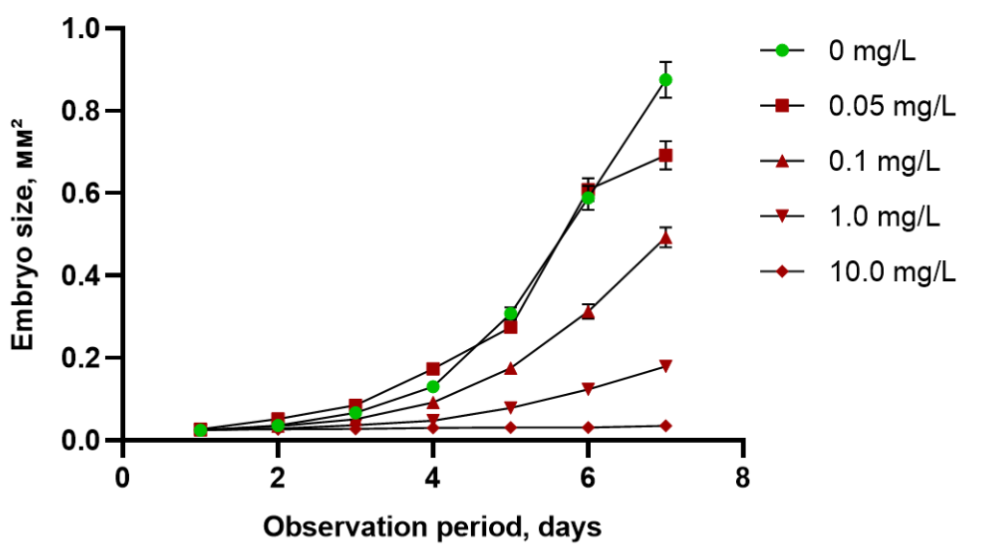
Dynamics of changes in Planorbidae embryo sizes under lithium exposure throughout the experiment
Growth inhibition in the mollusks exposed to lithium at concentrations of 0.1, 1.0, and 10.0 mg/L was recorded as early as day 2 of exposure. After 7 days of exposure, the size of the egg capsules treated with lithium at a concentration of 0.1 mg/L was 1.77-fold lower than that of the control group, and at a concentration of 1.0 mg/L, it was 4.88-fold lower. The most pronounced effect of lithium was observed at a concentration of 10 mg/L; by the end of the experiment, the size of the control capsules exceeded that of the exposed ones 25-fold.
The obtained results demonstrate the sensitivity of mollusk embryonic stages to lithium exposure and are consistent with data from earlier international studies. In particular, it has been shown that lithium exposure at concentrations starting from 0.015 mg/L can influence the growth of Marisa cornuarietis embryos
. Conversely, other studies on Mytilus galloprovincialis have reported a decrease in acetylcholinesterase activity and impairment of the antioxidant defense system in the presence of 0.1 mg/L of lithium, as well as an increased rate of burrowing into the bottom substrate in the gastropod Tritia reticulata at 0.5 mg/L .To evaluate the trend of the embryotoxic effect of lithium at the investigated concentrations on the mollusk egg masses, the ratios of the mean embryo sizes in the treatment solutions to those in the control group were assessed on days 1 and 7 of exposure, and a cumulative dose-response curve was constructed (Figure 2).
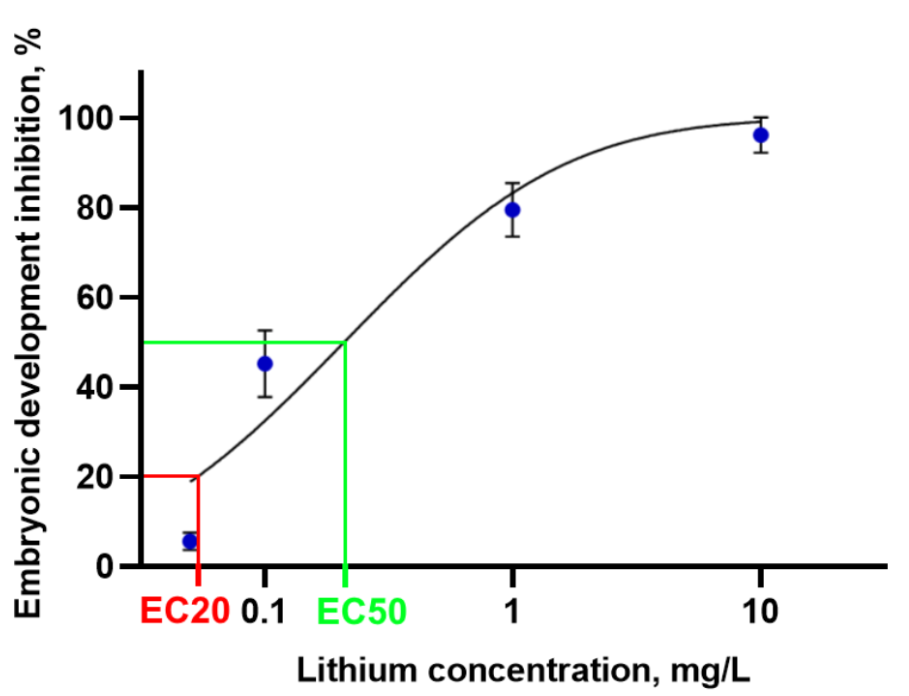
Dose-response curve for the effects of lithium ions on Planorbidae embryos
The values of the model’s coefficient of determination (R2 = 0.842) and the chi-squared statistic (X2 = 12.45), p = 0.002 for the probit model indicate a high degree of goodness-of-fit to the experimental data and confirm the adequacy of the obtained results.
In conclusion, the obtained results demonstrate the feasibility of utilizing Planorbidae embryo cultures as a test object to evaluate the impact of aquatic lithium pollution on the embryonic developmental stages of aquatic organisms. The findings of the present study can be further applied to the development and standardization of a biotesting method using mollusks of this family. Additionally, assessing the potential of Planorbidae mollusks as bioindicators of aquatic lithium contamination is of significant interest. The high sensitivity of these organisms to the toxicant and its inhibitory effect on growth processes indicate that under conditions of lithium pollution in a water body, the population may undergo degradation or complete extinction. Conducting experiments on real-world samples under conditions of lithium contamination represents a promising avenue for further research.
4. Conclusion
Based on the results of the conducted study, the feasibility of using gastropod embryos of the Planorbidae family as a test object under conditions of aquatic lithium pollution was determined. A dose-dependent pattern of lithium toxic action was established, and the effective concentrations of the element were compared against the MPC established for fishery water bodies: the EC₂₀ value was 0.07 mg/L (0.9 of the MPC) and the EC₅₀ value was 0.28 mg/L (exceeding the MPC by a factor of 3.5). Based on the evaluation of the ecological relevance of the test object to conditions characteristic of the aquatic environment, the determination of its sensitivity to lithium, the analysis of the test response, and the alignment of the experimental modeling results with the established standards for the element content in fishery water bodies, the use of these mollusk embryos holds significant promise for assessing the ecological status of aquatic environments affected by lithium pollution.